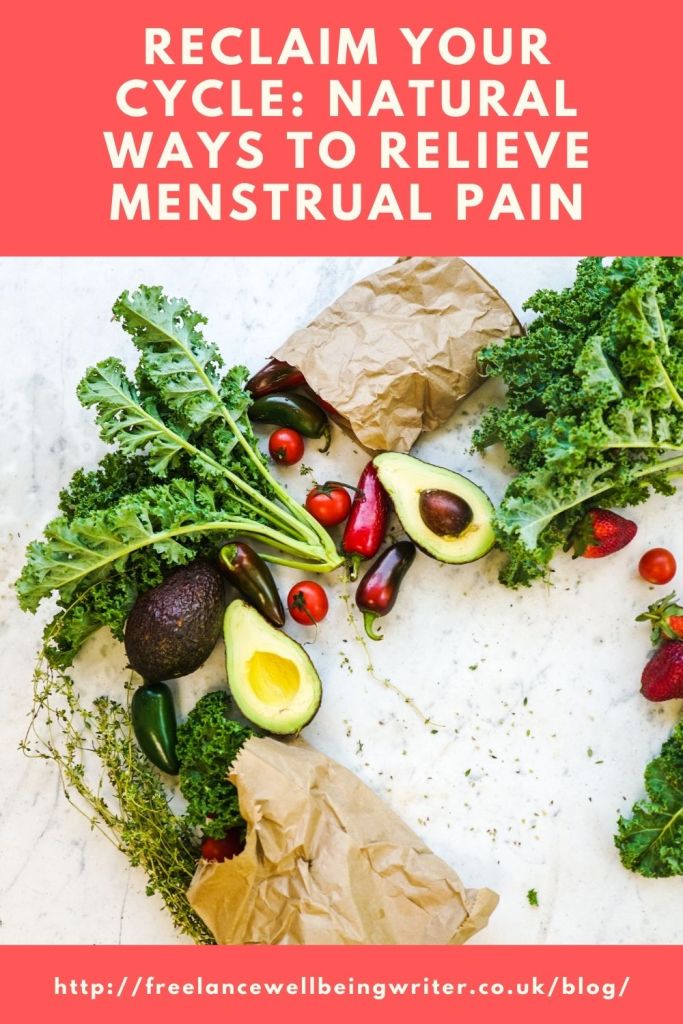
Reclaim your cycle: natural ways to relieve menstrual pain

I’ve been researching period pains lately, mainly because mine seem to have ramped up again. I don’t get them as badly as some people do – its not generally enough to put me out of action entirely. But they are bad enough. The most irritating part for me is that they tend to radiate into my arse, which makes standing still absolute hell for a couple of days. Walking is fine, lying down is fine, sitting is not great but manageable, standing… standing is achy, crampy horror.

Which would be fine, except I have kids.

And wow, do my kids like to take their time when we are walking anywhere. We seem to stop every ten steps so they can investigate a leaf, or examine an interesting wall, or throw a tantrum. All of which equals a lot of standing still.

I also find it hard to concentrate on work during the first couple of days of my period. It’s difficult to come up with brilliant writing ideas and pull together engaging copy when I’m distracted by cramps and trying to type with one hand clutching a hot water bottle to my abdomen.

Painkillers help a bit, but I don’t love having to take them regularly. And I’m resolute about not going back on the pill. It makes me angry and I don’t want to mess about with my hormones if I don’t have to.

So, diet and nutrition it is. Which, let’s face it, was always going to be my go-to.

Here’s what I’ve learnt so far…

Causes of period pains

There are conditions that cause bad menstrual pains, including endometriosis, uterine fibroids, adenomyosis, pelvic inflammatory disease, and structural abnormalities of the uterus itself. Having an IUD inserted for birth control can also cause painful cramps.

None of these apply for me, so I’m just dealing with regular primary dysmenorrhea (period pains, to the rest of us), like about half of all people who menstruate.

This means the most likely cause of my monthly cramps is a high-level of prostaglandins. These are natural chemicals found in our bodies, which act like hormones and play a role in reproduction, as well as our bodies’ natural healing process.

During our periods, prostaglandins cause our uterus to contract to expel the lining, ready for a new cycle to begin. An imbalance in prostaglandins causes inflammation and painful menstrual cramps.

Combatting period pains with diet and nutrition

If you are experiencing period pains that are caused by an underlying condition, definitely seek medical advice on addressing the condition itself, as well as looking at dietary solutions. For those of us who are just battling higher prostaglandin levels, looking at our diet might be helpful in managing the symptoms.

Since cramps are caused by inflammation, Better Nutrition suggests eliminating foods that raise our levels of prostaglandins. These include:

  • Processed vegetable oils – I cook a lot with sunflower oil, so need to address this one asap
  • Fried foods – this one isn’t a major one for me, but I’ll keep it in mind
  • Partially hydrogenated oils – apparently these are present in margarine, as well as many baked goods, so I suspect I’ve been eating quite a lot of them lately… colder weather always has me reaching for sweet, carby things
  • Processed meats – I don’t eat much meat but will keep an eye on this
  • Dairy products – huh. I don’t drink milk, but might need to look at my cheese intake…
  • High-glycaemic foods – yep, doing terribly here. This includes things like white rice, white pasta, potatoes, couscous etc. See Harvard Health for a helpful list. Lately I’ve been eating a lot of these on a daily basis which I suspect is why my cramps have been worse than they were in the summer when I wasn’t eating as much
  • Sugar – yep. See above re baked goods. Could do better here too
  • Alcohol – ah. I’m generally pretty good about not drinking regularly these days (there’s a family history of alcoholism that I’m very conscious of). But my husband is currently on furlough and we’ve been sharing a bottle of wine several nights a week. Time to limit alcohol to Friday and Saturday night again

This list doesn’t surprise me in the least, because it seems anytime I start researching which foods to avoid for a given issue, most of these key culprits are on the list.

But if these are the foods we shouldn’t eat if we want to reduce menstrual cramps, what are the ones that we should be eating instead?

Here’s what I’ve discovered about the nutrients we should be looking out for to avoid painful cramps…

1. Zinc

Dr Lara Briden, author of the Period Repair Manual, says that her favourite supplement for managing period pains is zinc. This is because studies have demonstrated that its anti-inflammatory properties are effective in reducing menstrual cramps. You can take zinc as a supplement and find it in foods such as pumpkin seeds, oats, red meat, oysters, almonds, and legumes.

2. Fibre

I wrote a piece for a client not that long ago about the magic of fibre for our health, so I’m not at all surprised to find from this study that not getting enough fibre is associated with increased menstrual pain. Foods that are rich in fibre include legumes, cruciferous vegetables like broccoli and collard greens, fruit, and whole-grains.

3. Omega-3

According to Nicole Jardim, author of Fix your Period, not having enough Omega-3 in your diet can make your period pains worse. This is because there are two main types of prostaglandins. One type, PGE2, causes inflammation, leading to pain. The other, PGE1, actually reduces inflammation instead. And PGE1 is derived from Omega-3.

So to get the benefits, we need more Omega-3 in our diets. Good sources include oily fish, flax and chia seeds, walnuts, avocados and, annoyingly, Brussel sprouts, which I hate. Fortunately, I love the rest of this list and am more than happy to eat more of them, especially since walnuts are also on my list of foods that boost brainpower.

4. Beta-Carotene

Research has found that adolescents with higher levels of beta-carotene (and zinc and vitamin E) were less likely to experience painful periods. Beta-carotene is a red-orange pigment found in vegetables such as carrots, squashes, and sweet potatoes.

5. Vitamin E

As explained above, vitamin E is one of the nutrients that has been found to reduce the likelihood of having menstrual cramps. Find it in almonds, sunflower seeds, avocados, spinach, broccoli, and olive oil.

6. Ginger

Ginger tea is often suggested as a home-cure for menstrual cramps and with very good reason. Studies have found that ginger is as effective as painkillers like ibuprofen and mefenamic acid for controlling period pains. I’m not a fan of it in drinks, but love to use ginger in cooking. I’ve also found adding a few drops of ginger essential oil to a hot bath is good for relieving cramps.

7. Magnesium

It seems that magnesium is good for pain management generally, according to researchers who looked at the evidence for its effect on a range of different symptoms. The reason for this needs more research but one of the conditions that magnesium is thought to be helpful for is period pains.

You can find magnesium in foods such as dark chocolate (hurray!), legumes, avocados, almonds and cashews, and pumpkin seeds. I also have a magnesium supplement that is a gel you rub on your skin to relieve muscle cramps. I haven’t tried it yet for menstrual cramps but I’m going to the moment I finish typing this up!

Some of my favourite foods are on this list, so I’m excited to do an overhaul of my diet this month to see if it helps with my cramps. I’ll let you know how it goes!

References

Nagata C., K. Hirokawa, N. Shimizu, H. Shimizu (2005) Associations of menstrual pain with intakes of soy, fat and dietary fiber in Japanese women, European Journal of Clinical Nutrition 59(1), pages 88-92, https://doi.org/10.1038/sj.ejcn.1602042

Ozgoli, G., M. Goli, and F. Moattar (2009), Comparison of Effects of Ginger, Mefenamic Acid, and Ibuprofen on Pain in Women with Primary Dysmenorrhea, the Journal of Alternative and Complementary Medicine 15 (2), pages 129-132, http://doi.org/10.1089/acm.2008.0311

Pramanik, P., S. Banerjee, and P. Saha, (2016), Primary dysmenorrhea in school-going adolescent girls – is it related to deficiency of antioxidant in diet? International Journal of Life Science and Pharma Research 5 (2), pages 54-63, http://www.ijlpr.com/admin/php/uploads/233_pdf.pdf

Shin, H.J., H.S. Na, and S.H. Do (2020) Magnesium and Pain, Nutrients 12(8), page 2184, https://doi.org/10.3390/nu12082184

Teimoori, B., M. Ghasemi, Z. S. A. Hoseini, M. Razavi (2016) The Efficacy of Zinc Administration in the Treatment of Primary Dysmenorrhea, Oman Medical Journal 31 (2), pages 107-111, https://doi.org/10.5001/omj.2016.21

Prostaglandins, the Society for Endocrinology, https://www.yourhormones.info/hormones/prostaglandins.aspx, consulted 07/11/2020

Dietary solutions for menstrual cramps, Better Nutrition, https://www.betternutrition.com/conditions-and-wellness/menstrual-cramps-diet/, consulted 07/11/2020

Glycemic index for 60+ foods, Harvard Health, https://www.health.harvard.edu/diseases-and-conditions/glycemic-index-and-glycemic-load-for-100-foods, consulted 07/11/2020

Why Zinc Is My Favorite Supplement for Period Health, Lara Briden, https://www.larabriden.com/7-ways-zinc-rescues-hormones/, consulted 07/11/2020

The top foods high in zinc, Medical News Today, https://www.medicalnewstoday.com/articles/325916, consulted 07/11/220

Why Omega-3 oils can help relieve period pain, Nicole Jardim, https://nicolejardim.com/cause-of-painful-periods-1/, consulted 07/11/2020
Really annoying advice on writer’s block (that works)

I kinda hesitated to write this post because I don’t like this piece of advice and I wish it didn’t hold true for me. But it does. And not just when I’m struggling to write either – even when the words are flowing freely, I have to do this thing before I can sit down to write.

Ready to find out what it is?

Tidy up.

I know. That’s not what you were after. You’re probably thinking; ‘Lucy, you promised me useful advice to tackle writer’s block and what you give me is tidying? I’m off.”

I told you it was going to be annoying. But stay with me a moment longer because there’s scientific basis to this claim. Let me explain.

The science and psychology

When our work environments are cluttered and disordered, it creates visual confusion. Our brains need to work harder to process the scene and to pick out individual items, leaving us with less brain power available for other tasks, like coming up with great writing ideas.

Research has also found that messy spaces are linked with increased stress and procrastination, both at home and at work.

One study, for example, compared how women described their homes with their levels of the stress hormone, cortisol. Those who said their homes were cluttered were more likely to exhibit higher cortisol levels.

Another study looked at cluttered workspaces and found that there was a link between procrastination and workplace mess.

Since stress and procrastination are both a big part of writer’s block, it makes sense that tidying up can help us get unstuck.

Trying to write in a messy room

Although I am sure this will shock my mother, who still remembers the state of my teenage bedroom with a shudder, I’m well aware of the effect a cluttered environment has on my ability to concentrate. I find it both distracting and slightly stressful to sit in a messy room.

Since I live with two small children in an open plan flat, my workspace is usually a complete tip. I’ve learnt that I need to deal with the mess before I can sit down to write, or I won’t get anywhere.

And it seems that I am not alone. The rising popularity of minimalism and the success of Marie Kondo demonstrate that plenty of other people want their interiors to feel ordered and mess-free.

Getting tidy

If you are lucky enough to have a dedicated study, or at least a space that is away from your main living area, you hopefully won’t find it takes too long to put everything in order. Because I work at our kitchen table, in a room that also functions as a living room, kids’ playroom, study, dining room… tidying up can take a while!

Don’t get me wrong, it is definitely worth it. Putting my physical space in order seems to unblock my mental space too – is this something you find?

If I’m stuck for ideas when I first get started, I often find that they come to me as I tidy.

Cleaning the bathroom is good for this too, it turns out, but I’d rather organise the living room than clean the toilet…

Embracing minimalism

Still, I do need to spend some time actually writing, or tidying becomes a procrastination method rather than a means to an end. I’ve tried to set up our space so that it is naturally organised and uncluttered.

We are big advocates of minimalism in our household. This is partly a matter of necessity, since there are four of us sharing a two-bed flat, and partly a matter of ethics – I try not to put too much importance on stuff.

Even so, we’d fallen into some bad habits at the beginning of this year. Luckily, moving to homeworking has meant that I’ve had plenty of opportunity to notice where our storage or systems were letting us down and to put them right.

Now when I want to write, it takes me much less time to put everything in order, which is a real relief.

Although this is obviously anecdote, rather than science, I genuinely believe that sorting out and decluttering our space has made me more productive as a writer and prevents me from getting writer’s block as often.

Resources to get you started

Have I sold you on the tidying idea yet? If you are sort of convinced but not yet sure how to put this into action, here’s a list of 3 resources I found helpful in inspiring me to tackle writer’s block by decluttering and tidying our home:

Hannah Bullivant ‘s blog, newsletter, and e-courses [https://www.hannahbullivant.com/]

I love everything Hannah produces – she’s a stylist who specialises in clutter-free, seasonally inspired interiors. I don’t know her personally but have been an avid fangirl since I discovered her Instagram a few years ago.

Back in Spring 2020, when the UK was first going into lockdown, Hannah put together a free five-day e-course to help us all turn our homes into beautiful, organised sanctuaries. I notice she’s since fleshed out and expanded the original short course to make a full two-month course. I’ve not done the paid-for version yet, but it is definitely on my wish-list. If your budget won’t stretch to the course at the moment, Hannah also offers loads of advice via her mailing list and Instagram, so there’s plenty to inspire you.

Madeleine Olivia’s YouTube channel [https://www.youtube.com/channel/UC4CpQoAPJNGGUPG92Fbwxqw]

I first discovered Madeleine Olivia because she shares lots of vegan content (I’m not vegan, but I do try to eat vegan meals several times a week). But I stayed because she has loads of videos on decluttering that I found useful. And a really cute dog.

Madeleine has also written a book on minimalism (called Minimal) which I haven’t read yet but is another item for the wish-list. I may have to direct my husband to this blog post for Christmas ideas…

The Fly Lady [http://flylady.net/]

I was pointed to the Fly Lady by my mother, so you know this is a great recommendation! To be honest, I had to unsubscribe from the emails after about a week because she sends so many. But there’s a helpful UK based Facebook group and the website has lots of resources too. The Fly Lady is all about setting up systems and doing a little each day, which means your home never gets too messy and you can just have a quick straighten up when you need to concentrate on your writing.

I hope you’ve found this post useful and perhaps less annoying than you first thought! Let me know in the comments if you also find tidying up helps to release your creative flow.

References

Bravo, M.J. and H. Farid (2006) Object recognition in dense clutter, Perception & Psychophysics 68, pages 911–918, https://doi.org/10.3758/BF03193354

Ferrari, J.R., C. A. Roster, K.P. Crum & M.A. Pardo (2018) Procrastinators and Clutter: An Ecological View of Living with Excessive “Stuff”, Current Psychology (37), pages 441–444, https://doi.org/10.1007/s12144-017-9682-9

Stephanie McMains and Sabine Kastner (2011) Interactions of Top-Down and Bottom-Up Mechanisms in Human Visual Cortex, Journal of Neuroscience 31 (2), pages 587-597, https://doi.org/10.1523/JNEUROSCI.3766-10.2011

Roster, C.A. and J.R. Ferrari (2020) Does Work Stress Lead to Office Clutter, and How? Mediating Influences of Emotional Exhaustion and Indecision, Environment and Behaviour 52 (9), pages 923-944, https://doi.org/10.1177%2F0013916518823041

Saxbe, D.E. and R. Repetti (2009) No Place Like Home: Home Tours Correlate With Daily Patterns of Mood and Cortisol, Personality and Social Psychology Bulletin 36 (1), pages 71-81, https://doi.org/10.1177%2F0146167209352864

Stuck for ideas? 5 foods to boost your brainpower

I’m a freelance writer, so I constantly need to come up with ideas for posts, bid for work, and write sparkling copy that helps my clients meet their aims. Usually the words come easily. But sometimes it is like wading through sludge. If you also need an occasional brain boost, here are 5 foods to try.

If you’ve ever had to go without your morning coffee, you know that what you eat and drink can affect your ability to think. Skip your daily caffeine dose and you find your thoughts slow down to a crawl. But eat the right foods and you can kick your brain into a new gear, boost your cognitive function, and get those neurons firing again. Let’s take a look at the foods you need if you are stuck on coming up with new ideas.

1. Berries

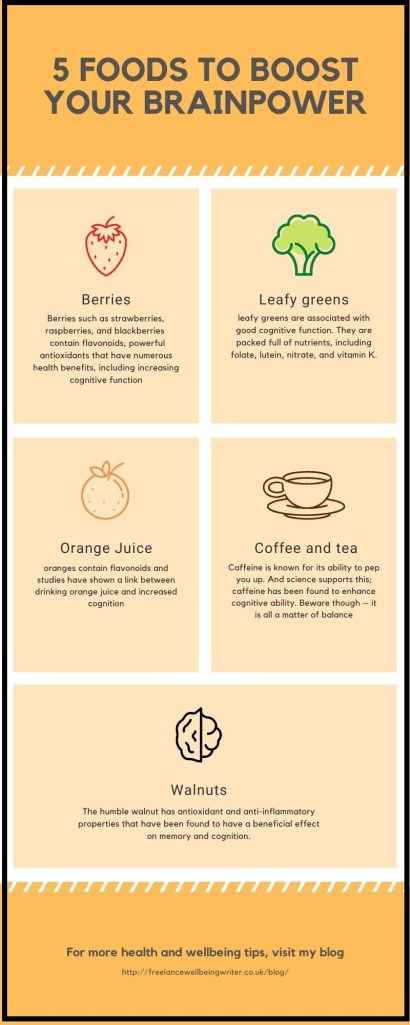
You’ve probably heard before about the powers of blueberries. These juicy little bites are often touted as a super-food, boosting brain function, fighting cancer, and preventing heart disease. But the effects aren’t limited to blueberries alone. Berries such as strawberries, raspberries, and blackberries also contain flavonoids; powerful antioxidants that have numerous health benefits, including increasing cognitive function. This is great news if you are like me and prefer a bowl of strawberries to a handful of blueberries.

2. Leafy greens

I love spinach, so I am thrilled to find that leafy greens are associated with good cognitive function. They are packed full of nutrients, including folate, lutein, nitrate, and vitamin K. If you aren’t such a fan of spinach, other options include kale, collard greens, and broccoli. Aim for at least one portion of leafy greens a day to keep your brain sharp.

3. Orange juice

Not just deliciously thirst-quenching, orange juice has also been found to prevent poor brain performance. Like berries, oranges contain flavonoids and studies have shown a link between drinking orange juice and increased cognition. Oranges are also famously rich in vitamin C, so they’ll help to prevent you getting sick. We all know how hard it is to feel inspired when you are under the weather. Make sure you choose a juice that contains actual oranges. Or go the whole hog and squeeze your own at home for ultimate benefit.

4. Tea or coffee

If you are anything like me, the first thing you do when you feel stuck is reach for the kettle. Caffeine is known for its ability to pep you up, so many of us use it to awaken our brains. And science supports this; caffeine has been found to enhance cognitive ability. Beware though – it is all a matter of balance. Too much caffeine can take you the other way and actually reduce your ability to concentrate. And, of course, drinking too much can prevent you sleeping well at night, which leads to more groggy days.

5. Walnuts

Almonds seem to get all the hype when it comes to nut-based super-foods, but the humble walnut has antioxidant and anti-inflammatory properties that have been found to have a beneficial effect on memory and cognition. And there are signs that they may assist in preventing depression, strokes and Parkinson’s Disease too. Plus they are an easy snack to have on hand and nibble on throughout the day.

Do you need readable, science-based content like this for your own health & wellbeing website? Find out how I can help.

References

Chauhan, A. and V. Chauhan (2020), Beneficial Effects of Walnuts on Cognition and Brain Health, Nutrients 12 (2), page 550, https://doi.org/10.3390/nu12020550

Huntley, A.L. (2009), The health benefits of berry flavonoids for menopausal women: Cardiovascular disease, cancer and cognition, Maturitas 63 (4), pages 297-301, https://doi.org/10.1016/j.maturitas.2009.05.005

Kean, R.J., D.J. Lamport, G.F. Dodd, J.E. Freeman, C.M. Williams, J.A. Ellis, L.T. Butler, and J.P. Spencer (2015), Chronic consumption of flavanone-rich orange juice is associated with cognitive benefits: an 8-wk, randomized, double-blind, placebo-controlled trial in healthy older adults, the American Journal of Clinical Nutrition 101(3), pages 506-514, https://doi.org/10.3945/ajcn.114.088518

Morris, M.C., Y. Wang, L.L. Barnes, D.A. Bennett, B. Dawson-Hughes, and S.L. Booth (2018), Nutrients and bioactives in green leafy vegetables and cognitive decline: Prospective study, Neurology 90 (3), pages 214-222, https://doi.org/10.1212/wnl.0000000000004815

Nehlig, A. (2010) Is Caffeine a Cognitive Enhancer? Journal of Alzheimer’s Disease 20 (1), pages 85-94, https://doi.org/10.3233/jad-2010-091315

What to do if anxiety is stealing your sleep

As a freelance writer, I often find that work-related anxiety keeps me up at night. I lie awake, compiling to-do lists, making plans, and drafting posts. All when I should be sleeping. If anxiety is stealing your sleep too, this post is for you. Here are my top three tips for getting a better night.

A good night’s sleep is fundamental to our wellbeing – being well-rested can help to combat depression, boost low self-confidence, and even reduce the risk of chronic illness and obesity. But in these unsettled times, anxious thoughts can easily steal our sleep and leave us feeling run-down. If you find yourself lying awake at 3 am with your thoughts racing, here are some ways to reclaim your rest.

1) Establish a relaxing evening routine

Start your evening routine well in advance of going to bed to encourage your mind and body to wind down ready for sleep. Incorporate comforting activities to soothe yourself after the stresses of the day – perhaps a warm bath, some gentle yoga, or a non-caffeinated hot drink. Try to set yourself a regular bedtime and stick to it. Establishing some relaxing evening rituals and settling into bed at roughly the same time each night helps your body and mind know that it is time to sleep.

2) Avoid screens

Stay away from screens for at least two hours before you plan to go to sleep, ideally more. The blue light emitted by electronics, such as your phone, computer, or TV, can delay the release of the sleep promoting hormone melatonin, making it harder to fall asleep. Not only that, the constant exposure to new information from social media and the news can send your mind whirring and feed your anxiety. Make your bedroom a screen-free zone if possible. If you need to have your phone by you, turn off the screen and put it slightly out of reach so you are less tempted to reach for it for one last scroll.

3) Tackle the underlying cause

Tactics that promote better sleep are a good start to reclaiming your night’s rest. But if your anxiety is persistently robbing you of sleep, it is time to tackle the anxiety itself. Seeing a counsellor or therapist can do wonders – when I was really struggling with anxiety in 2019, three months of weekly counselling sessions went a long way to getting me back on my feet. Look for someone who specialises in anxiety. Lots of counsellors now offer remote sessions too.

Want content like this for your own site? Find out more about my blog writing services.

References:

Blue light has a dark side, Harvard Health Publishing, https://www.health.harvard.edu/staying-healthy/blue-light-has-a-dark-side, consulted 17/10/2020

How to get to sleep, NHS UK, https://www.nhs.uk/live-well/sleep-and-tiredness/how-to-get-to-sleep/, consulted 17/10/2020

Sleep Deprivation and Deficiency, National Heart, Lung, and Blood Institute, https://www.nhlbi.nih.gov/health-topics/sleep-deprivation-and-deficiency, consulted 17/10/2020